
Gold Coast Pool Restorations · Pool Care Guide
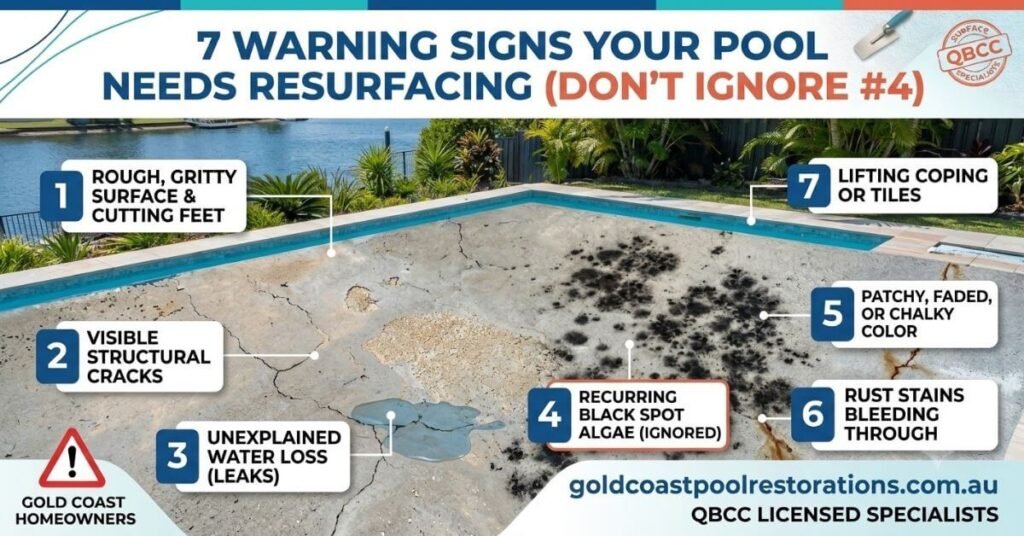
7 Warning Signs Your Pool Needs Resurfacing
(Don't Ignore #4)
Most Gold Coast homeowners don't wake up one day and decide their pool needs resurfacing. It's usually a slow build-up of small annoyances — a rough patch here, a stain that won't scrub out there — until one day you're standing at the edge wondering if it's actually serious, or if you're overreacting.
Here are the 7 signs that mean it's time to stop wondering and get it properly assessed. Some are cosmetic. A couple mean your pool shell is telling you something more urgent.
The surface feels rough, gritty, or is cutting feet
Run your hand along the pool floor or walls. If it feels sandpapery rather than smooth, the surface finish is breaking down. This isn't just uncomfortable — a degrading surface is more porous, which means algae and stains take hold faster and are harder to remove.
Visible cracks in the floor, walls, or steps
Hairline cracks are common in ageing concrete pools and aren't automatically an emergency. But any crack you can feel with a fingernail, or one that seems to be growing, is worth having assessed. Left alone, cracks let water seep into the shell and can worsen with ground movement — a genuine risk in some Gold Coast beachside and hinterland soil conditions.
You're topping up the water more than evaporation explains
A pool naturally loses some water to evaporation, especially over a Gold Coast summer. But if you're topping up noticeably more than a centimetre or two a week, and there's no obvious splash-out from kids or pets, a structural leak is the more likely explanation — and resurfacing is usually how it gets permanently sealed.
Black spot algae keeps coming back no matter how much you clean
The colour has gone patchy, faded, or chalky
UV exposure and salt air — both intense on the Gold Coast — break down pigment in ageing pool surfaces over time. If your water looks duller than it used to, or you can see uneven patches of colour around the pool, the finish itself has worn past what a clean or a re-tile can fix.
Rust stains are bleeding through the surface
Brown or orange staining, especially around the edges of small cracks, usually means the steel reinforcement (rebar) inside a concrete shell has started corroding and the rust is migrating through to the surface. This needs treatment before it spreads further — resurfacing includes grinding back, treating the rust, and sealing it in properly.
Coping, tiles, or the waterline are lifting or falling away
If waterline tiles are popping off, coping stones are shifting, or you're finding grout crumbling out, it's often a sign of movement or moisture getting underneath — and it's worth having assessed at the same time as the pool surface itself, since a resurface is the easiest time to address both.
Is It Time to Clean, or Time to Resurface?
A good rule of thumb: if a proper clean and chemical rebalance fixes the issue and it doesn't come back within a few weeks, you probably don't need to resurface yet. If the same problem keeps returning, or you're seeing any of signs 2, 3, 6, or 7 above, it's worth getting an on-site opinion rather than guessing.
Frequently Asked Questions
Can I just repaint my pool instead of resurfacing it?
Paint can mask some cosmetic fading for a short time, but it doesn't address rough texture, cracks, or rust underneath — and it tends to peel faster on a surface that's already degrading. If more than one of the signs above applies to your pool, painting is a temporary patch rather than a fix.
How urgent is a small crack, really?
Small, stable hairline cracks in a concrete shell are common and not usually an emergency on their own. The risk is when a crack is actively letting water through (see sign #3) or growing over time. An on-site inspection can tell you which kind you're dealing with in a few minutes.
Will resurfacing get rid of black spot algae for good?
Yes, in almost all cases. Because resurfacing removes and replaces the degraded surface layer the algae has rooted into, it eliminates the hiding spot rather than just treating the symptom — which is why it succeeds where repeated chemical treatment alone doesn't.
How do I know what my resurface would actually cost?
It depends on your pool's size, current condition, and the finish you choose. Our free 60-second Pool Price Check gives you a personalised price band based on your exact pool, and a QBCC-licensed specialist can confirm the exact number with a free on-site assessment.
Not Sure Which of These Applies to You?
Take our free 60-second Pool Price Check — answer a few quick questions about your pool's size and condition and get a personalised price band on the spot, then get matched with a QBCC-licensed specialist for an exact, written quote.
Take the Pool Price Check →100% obligation-free · Matched within 24 hours · QBCC licensed & insured specialists only
Related Reading
Gold Coast Pool Restorations — goldcoastpoolrestorations.com.au — 0494 596 484
Ready to find out exactly what your pool needs?
Get matched with a trusted, QBCC-licensed Gold Coast specialist. Free assessment. No hidden fees. Quote within 24 hours.